Download App
5 Signs Your Store Is Invisible to AI Platforms
E-Commerce SEO
Feb 11, 2026
Spot five signs your Shopify store is invisible to AI shopping assistants and learn practical fixes for schema, collections, metadata, tracking, and conversational setup.

AI is changing how people shop, and most Shopify stores are missing out. If your store isn't visible to AI platforms like ChatGPT or Perplexity, you're losing customers. Here's what to watch for:
No structured data: Without machine-readable data, AI can't understand your products.
Messy collections: Poorly organized categories confuse AI and make your store irrelevant.
Weak metadata: Vague or inconsistent product details get ignored by AI systems.
No AI tracking: If you don't monitor AI mentions, you won't know where you're falling short.
Lack of conversational commerce setup: Missing tools like
llms.txtor detailed FAQs leave you out of AI recommendations.
Why it matters: AI-driven shopping is growing fast. Over 33% of consumers - and nearly 50% of Gen Z - use AI for product discovery. Stores that optimize for AI now will thrive, while others risk being left behind. Fixing these gaps means better visibility and more sales in the AI era.
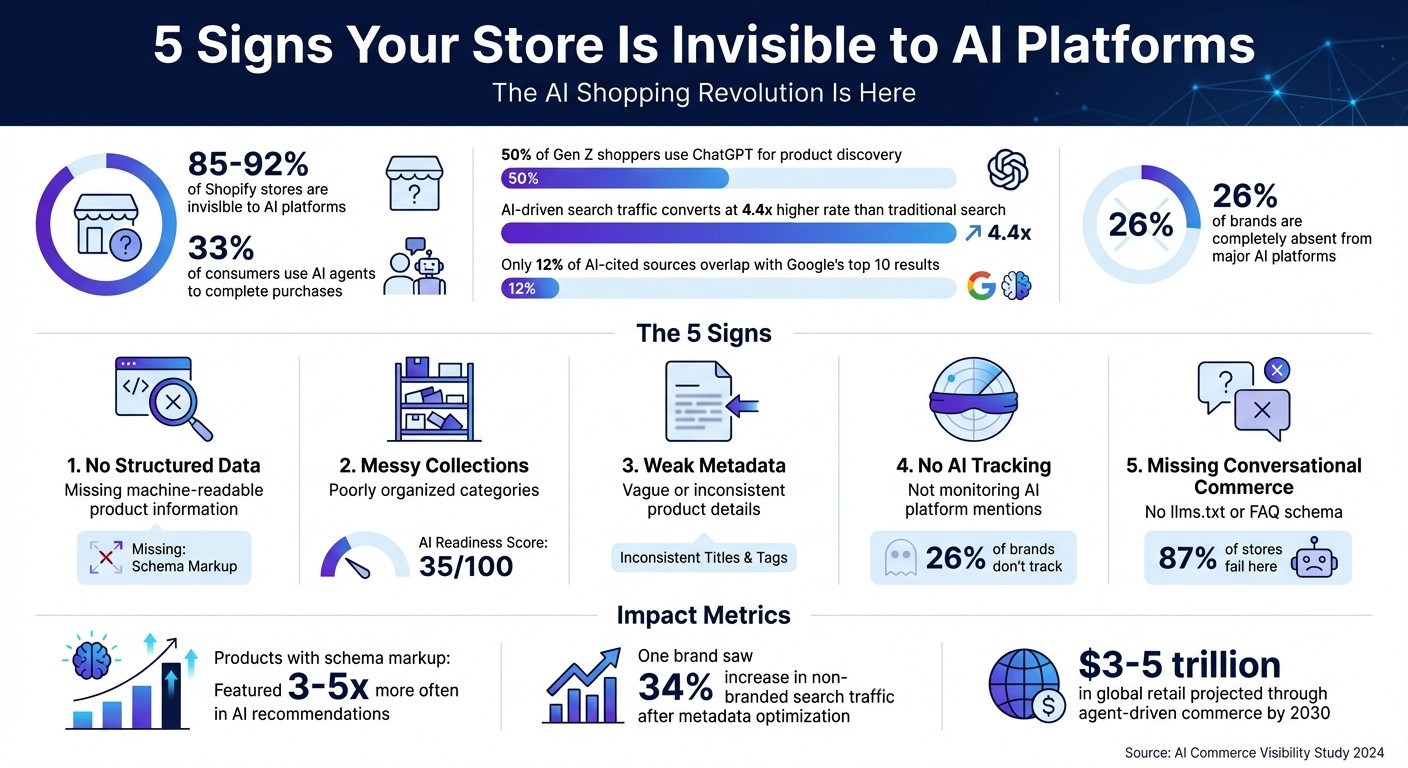
AI Platform Visibility Statistics for Shopify Stores
Own a Shopify store? Do this RIGHT NOW to optimize your listings for AI commerce (agentic commerce)

Sign 1: Missing or Incomplete Structured Data
Structured data is the key that helps AI systems like ChatGPT, Perplexity, and Google's AI Overviews understand your store and its products. Without it, these platforms can’t accurately identify details like product descriptions, pricing, or stock levels. Unlike humans, AI doesn’t browse your site - it relies on structured, machine-readable signals to extract information [10][11]. If your data is incomplete, AI systems will skip over your store in favor of competitors with better-organized information [10][11]. This can directly impact your store’s visibility and ranking on AI-driven platforms.
The numbers are striking: between 85% and 92% of Shopify stores are effectively invisible to AI-powered shopping assistants [1]. On the other hand, products with detailed schema markup are featured in AI-generated shopping recommendations 3 to 5 times more often than those without it [10].
How Structured Data Impacts AI Visibility
Incomplete or missing structured data erodes trust with AI systems. These platforms prioritize products with verified, accurate details to avoid errors or "hallucinations" - situations where the system generates incorrect information [3]. Without structured data, AI systems can’t perform basic tasks like filtering by price, checking stock, or using reviews to assess quality. This leaves an opening for competitors with more reliable data to take your place.
"Schema is what turns your store into machine-readable content and that's what AI systems require to understand, compare, and rank you." – Erlin AI [11]
While Shopify does provide basic schema markup, it often falls short. Many native themes lack critical properties like detailed availability, comprehensive review data, and technical specifications - details that AI platforms use to recommend products [1][5]. This gap highlights why only 12% of sources cited by AI platforms align with Google’s traditional top 10 search results [7]. Traditional SEO tactics alone aren’t enough; optimizing structured data is essential for gaining visibility in AI-driven ecosystems.
How to Fix It: Add Structured Data to Your Store
To improve AI visibility, implement JSON-LD for your schema markup. JSON-LD is the preferred format for AI platforms because it’s easier to maintain and integrates smoothly with modern systems [10][11]. Focus on what’s often called the "Schema Trio":
Product schema: Covers key product details like name, description, and images.
Offer schema: Includes pricing and availability information.
AggregateRating schema: Provides social proof through ratings and reviews.
These three types of schema are the foundation AI systems rely on to understand and rank your products [11][2].
Additionally, make sure to include unique product identifiers like GTIN, SKU, and MPN. These identifiers help AI platforms distinguish your products from similar ones, ensuring accurate comparisons [11][2]. Check your robots.txt file as well - many stores mistakenly block AI crawlers like GPTBot, ChatGPT-User, or PerplexityBot, effectively opting out of discovery [12]. Tools like MentionOS AI Store Optimization can streamline the process, helping you apply consistent schema markup to your entire product catalog. This ensures AI platforms can fully understand and recommend your store.
Sign 2: Poorly Organized Product Collections
Messy or generic product collections can confuse AI systems. To stay competitive in AI-driven commerce, your collections need to clearly communicate their purpose. If your category pages are nothing more than a product grid with vague titles like "Shop All" or "New Arrivals", AI platforms won’t know what to make of them. They won’t understand who the category is for or how the products relate to each other. The result? Your store gets overlooked when AI platforms like ChatGPT or Claude try to match products to customer queries.
The numbers back this up: a study of 1,000 Shopify stores found that category pages scored a dismal 35 out of 100 in terms of AI readiness [6]. Without clear descriptions and context, AI systems treat these pages as irrelevant noise.
Inconsistent labeling makes things worse. For instance, labeling one category as "noise-cancelling headphones" and another as "noise-canceling headset" creates confusion. AI struggles to group these products into a unified, machine-readable taxonomy [3].
Why AI Needs Clear Product Organization
AI platforms act more like answer engines than basic keyword matchers [5]. They rely on structured context to figure out how your products solve specific problems. For example, if a shopper asks, "What are the best shoes for marathon training in humid weather?" AI looks for collections organized by intent - like "Marathon Training Shoes" - rather than generic categories like "Running Shoes." Without that level of organization, AI won’t confidently recommend your products.
Disorganized collections also lead to "Variant Confusion" [9]. If AI can’t easily distinguish between product variations like sizes, colors, or configurations, it might skip your product altogether to avoid making an incorrect recommendation. This reflects the cautious nature of AI systems, which prioritize stores with clear, accurate data [3].
"AI systems are not choosing a position on a results page. They are deciding whether your content is clear enough to use in an answer." – Gentian Shero, Co-founder & CSO, Shero Commerce [6]
As search shifts toward context-driven queries, shoppers are asking more detailed and conversational questions, moving away from simple keywords. If your collections aren’t built to reflect how people shop and ask questions, AI platforms will redirect traffic to competitors who have done the work [8].
To address these challenges, you need to rethink how your product collections are organized.
How to Fix It: Reorganize Your Collections for AI
Here’s how you can make your collections more AI-friendly:
Add descriptive content to your collection pages. Include a short introduction (one to two paragraphs) that explains the purpose of the category and its target audience [6]. Use headings that resemble conversational queries, like "How to choose the right running shoes?" AI platforms can use these to better understand and recommend your products [6][7].
Standardize your taxonomies. Use consistent terms throughout your catalog and align them with Google Product Categories for better machine readability. For example, if you label something as "waterproof" in one collection, don’t switch to "water-resistant" in another. Additionally, Shopify’s duplicate URL structure (e.g.,
/products/nameand/collections/name/products/name) can confuse AI crawlers. Solve this by using canonical tags to point to the primary source of product data [3][5].Add comparison tools and FAQs. Include features like comparison cards or "best for" lists to help AI justify recommendations [6]. A brief FAQ section on your category pages also provides scannable data that AI can use to answer customer queries [7][6].
Sign 3: Generic or Inconsistent Product Metadata
Vague product titles and descriptions can seriously hurt your chances of being recommended by AI platforms. If your metadata sounds more like a sales pitch than a detailed spec sheet, AI systems struggle to match your products to customer searches. For example, if a shopper is looking for "waterproof hiking boots under $200" and your product is listed as "premium outdoor footwear" without specifics, your product won't show up. Inconsistencies in pricing, specs, or availability across different channels only make things worse. AI systems avoid recommending products with unreliable or conflicting data. Missing critical identifiers? The result is the same - your product gets skipped. Shockingly, 26% of brands are completely absent from major AI platforms, even if they perform well in traditional search rankings [7].
Want to increase your chances of being recommended? Start by refining your metadata. One personal care brand with mid-7-figure revenue saw a 34% jump in non-branded search traffic within just three months after updating their product descriptions to align with AI requirements [4]. AI systems have zero tolerance for ambiguity [9]. If your product specs are inconsistent or incomplete, AI will simply move on to a competitor with cleaner, more reliable data.
How AI Uses Metadata to Make Recommendations
AI platforms rely heavily on structured and consistent metadata to confidently recommend products. Think of them as "super-comparison shoppers" that analyze relationships between brands, products, and attributes. For instance, if a customer asks, "What's the best vitamin C serum for sensitive skin?" AI will prioritize products with metadata that clearly outlines skin type compatibility, active ingredients, and concentration levels.
Here’s what AI systems prioritize in metadata:
Core identifiers: GTIN, SKU, MPN
Technical details: Dimensions, materials, weight, compatibility
Commercial data: Real-time price, stock availability, currency
Contextual info: Intended user, ideal use cases, skill levels [3][13]
Without this structured data, your products are left out. A study revealed that only 12% of sources cited by AI platforms overlap with Google’s top 10 search results [7]. Success in traditional SEO no longer guarantees visibility in AI-driven recommendations.
Let’s break down how metadata quality impacts AI behavior:
Metadata Quality | AI Agent Behavior | Impact on Your Store |
|---|---|---|
Generic/Vague | Can't match user intent | Ignored for detailed queries |
Inconsistent | Detects conflicting data | Skips product to avoid errors |
Thin/Unstructured | Struggles to parse attributes | Excluded from comparison modules |
Structured | Confidently extracts product details | 3-5x higher recommendation frequency |
"If AI can't read your store, it won't rank your store." – Erlin.AI [11]
AI platforms are designed to minimize risk. They prefer products that are well-documented, widely reviewed, and clearly aligned with user needs [3]. If your metadata doesn’t provide these assurances, your products won’t make the cut.
How to Fix It: Standardize Your Product Metadata
Ditch the vague marketing language and focus on specifics. Instead of saying "luxurious comfort", describe your product with details like "memory foam insole, 1.5-inch cushioning, breathable mesh upper." Use consistent terminology across your catalog - choose either "noise-cancelling" or "noise canceling" and stick with it [3]. Align your product categories with standardized retail taxonomies like Google Product Category to help AI systems classify your items accurately.
Leverage tools like Shopify metafields to map technical specifications directly into your JSON-LD schema [2]. Include essential identifiers, such as GTINs, for every product. Brands with a 95%+ data completion rate are far less likely to be overlooked by AI systems [9]. Ensure your pricing, inventory, and specifications are synchronized in real-time across your Shopify store, product feeds, and third-party marketplaces. AI platforms penalize discrepancies [3][13].
To further refine your metadata, add sections like "Who is this for?" and "Who is this not for?" in your product descriptions. This helps AI agents understand trade-offs and make informed recommendations [3]. Structure product titles to mimic natural language queries. For example: "Salomon X Ultra 4 GTX – Waterproof, Lightweight, Trail Hiking Boots for Day Hikes" [13].
For founders and growth teams, improving metadata is a direct path to better AI-driven engagement. Tools like MentionOS can help Shopify brands optimize their product metadata for AI recommendation engines, ensuring your catalog meets the structured data demands of conversational commerce. Standardized metadata is the cornerstone of AI visibility.
Sign 4: No Tracking of AI Mentions or Recommendations
If you’re not tracking mentions of your brand on AI platforms, you’re missing out on crucial insights. These insights help you understand which queries bring up your brand, which competitors are getting recommended, and why AI assistants might favor others over you. Without this data, it’s nearly impossible to spot and fix gaps in visibility. Shockingly, 26% of brands don’t monitor their AI mentions, even if they perform well in traditional search rankings [7]. This lack of monitoring leaves businesses blind to areas that need improvement.
And the stakes? They’re getting higher. By late 2024, AI platforms drove 5.6% of search traffic, up from just 1.3% in January 2024 [14]. On top of that, more than one-third of consumers - and nearly half of Gen Z - already use tools like ChatGPT to discover products [1]. If your brand doesn’t make it onto an AI assistant’s shortlist of 3–5 recommendations, the revenue impact could be far worse than a slight drop in organic rankings. As TNG Shopper explains: "The gap between 'ranking' and 'being recommended' is where revenue disappears" [7].
Why You Need to Track AI Mentions
Tracking AI mentions isn’t just a nice-to-have - it’s essential for understanding how your brand is being represented and where improvements are needed. Monitoring AI-generated recommendations shows you where your store appears, where it doesn’t, and which queries drive the most visibility. It’s not about chasing numbers - it’s about understanding the narrative. Key metrics to track include:
Share of AI Answers: How often your brand appears in top AI recommendations.
Citation Frequency: How frequently your site is referenced in AI responses.
Sentiment Analysis: The tone used to describe your products [3].
Here’s a surprising stat: only 12% of sources cited by AI platforms overlap with Google’s traditional top 10 search results [7]. That means excelling in SEO doesn’t guarantee AI visibility. To bridge this gap, audit AI platforms directly by asking conversational questions like “What are the best [category] for [use case]?” or “What’s a good alternative to [Competitor Brand]?” [3][7]. If your brand isn’t mentioned, you’ve found a visibility gap. Even if it is, check how your products are described - a vague or negative tone could point to metadata issues.
How to Fix It: Start Tracking AI Visibility
Stop guessing and start tracking your AI visibility. Tools like MentionOS AI Visibility Tracking can help you monitor your brand mentions across platforms such as ChatGPT, Perplexity, and Google Gemini. These tools identify high-value queries where your brand is absent and highlight which competitors are dominating the conversation. Armed with this data, you can optimize your Shopify store for conversational commerce and turn AI visibility into a revenue driver.
Make tracking a habit. Conduct monthly audits by asking AI systems questions like “Alternatives to [Your Product]” or “Best [Category] for [Audience]” to keep tabs on how your visibility changes over time [3]. Additionally, use Google Search Console to spot discrepancies between impressions and clicks - if impressions are high but clicks are low, it could mean AI Overviews are answering users’ questions without directing traffic to your site [14]. Finally, analyze referral traffic in Google Analytics 4 to see how much comes from AI platforms [6]. Without proper tracking, you’re likely leaving revenue on the table. With it, you can identify and close those gaps before your competitors do.
Sign 5: Missing Conversational Commerce Setup
Even if your SEO strategy is solid, neglecting conversational commerce could leave your store invisible to AI assistants. In fact, about 87% of Shopify stores fail to appear on platforms like ChatGPT, Perplexity, and Gemini [1]. Why? Many stores lack the technical setup these AI systems require - things like machine-readable data, detailed FAQs, or specific files like llms.txt. Without these, your store doesn't register in the world of conversational shopping, which means you're missing out on a growing segment of high-intent buyers.
Here's why this matters: AI-driven search traffic converts at a rate 4.4 times higher than traditional search traffic [16]. When AI assistants can't access or understand your store, you're essentially shutting the door on some of the most motivated shoppers out there.
"AI systems don't guess. They promote products they can understand clearly and ignore the rest" [17].
Why Conversational Commerce is Key for AI Discovery
AI assistants are reshaping how people shop. They don't just rank links like traditional search engines; instead, they synthesize answers by analyzing site feeds, reviews, and structured data to recommend products. This means your store must provide clear, machine-readable information to even be considered.
Traditional SEO focused on keywords and rankings. Conversational commerce, on the other hand, revolves around answering natural-language questions. If your product pages don't include clear, scannable overviews, detailed specifications, and FAQ schema, AI assistants are likely to recommend your competitors instead.
Here’s a big issue: 72% of stores use technical setups, like JavaScript-heavy themes, that make it hard for AI crawlers to interpret their content [1]. On top of that, many stores accidentally block AI crawlers in their robots.txt file - often because they opted out of AI training in recent years.
How to Fix It: Optimize for Conversational Commerce
To make your store AI-friendly, start with these steps:
Check your
robots.txtfile to ensure you're not blocking important bots likeOAI-SearchBot[15]. Then, upload anllms.txtfile to your root domain. This file acts as a guide for AI crawlers, summarizing your site and pointing them to key pages [15]. Since Shopify doesn’t support hosting this file natively, consider a third-party solution like MentionOS, which offers fullllms.txtcustomization starting at $29/month.Ensure all key product details - like titles, prices, descriptions, and specifications - are accessible in raw HTML, not just via JavaScript [1].
Enhance your FAQs. Use tools like the Shopify Knowledge Base App to add 3–7 real buyer questions to each product page. Questions like "Who is this for?" or "How do I choose the right size?" resonate with how shoppers naturally think. Pair these with FAQ schema to make them scannable by AI systems [6].
Create buying guides and comparison content. Pages like "Best [Product] for [Scenario]" or detailed comparison tables (e.g., "Product A vs. Product B") are ideal for AI-generated answers [6]. Keep in mind, only 12% of sources cited by AI platforms overlap with Google’s traditional top 10[7]. Optimizing for conversational discovery requires a different approach from traditional SEO.
Finally, consider using MentionOS AI Visibility Tracking to monitor how your store appears across platforms like ChatGPT, Perplexity, and Google Gemini. This tool not only identifies gaps in your AI presence but also provides competitor analysis and AI-optimized content tools. Starting at $29/month, it can help turn conversational commerce into a measurable revenue channel for your Shopify store.
Conclusion: Prepare Your Store for AI-Driven Commerce
Right now, 85% to 92% of Shopify stores are invisible to AI platforms like ChatGPT, Perplexity, and Gemini [1]. If your store is among them, you're not alone - but here's the good news: these problems can be fixed. And the stores that take action now will position themselves to capture a massive share of the market as AI-driven discovery becomes the norm.
The numbers speak for themselves. McKinsey projects that $3 to $5 trillion in global retail will flow through agent-driven commerce by 2030 [18]. This isn’t some distant trend - it’s happening now. Already, 33% of consumers are using AI agents to complete purchases [18], and nearly 50% of Gen Z shoppers rely on tools like ChatGPT to discover products [1]. The shift to conversational commerce is moving even faster than the transition to mobile search did.
"The question isn't whether agent commerce will matter. It's whether your store will be visible when it does."
These changes demand immediate attention. Merchants who invest in upgrading their data infrastructure, schema markup, and conversational tools will lead the ecommerce space. Those who don’t? They risk being left behind, excluded from key AI-driven recommendations. Traditional SEO strategies are no longer enough to ensure visibility in this new landscape [7].
MentionOS is here to help Shopify brands adapt. Their platform offers tools for AI visibility tracking across ChatGPT, Perplexity, and Gemini, competitor analysis to identify gaps, AI-optimized content creation tools, and full llms.txt customization - all starting at just $29/month. With MentionOS, you can turn conversational commerce into a measurable revenue driver and make sure your store is part of the AI conversation.
FAQs
How do I check if AI bots are blocked from my Shopify store?
To make sure your store is discoverable by AI platforms, take a moment to check your robots.txt file. This file manages how web crawlers and AI bots interact with your site. Make sure it’s set up to allow access to AI crawlers, such as OpenAI's OAI-SearchBot.
You can also test how bots view your site using tools that simulate bot access or by querying AI assistants directly. Configuring your robots.txt file correctly is key, especially as AI continues to play a growing role in shaping shopping habits.
What structured data fields matter most for AI product recommendations?
Key structured data fields for AI product recommendations include Product, AggregateRating, and FAQ schemas. These elements, combined with detailed comparison tables and genuine reviews, enable AI systems to better understand and recommend your products. By organizing your data effectively, you can boost your visibility and relevance on AI-powered platforms.
What should I put in an llms.txt file for a Shopify store?
Your llms.txt file should contain well-organized, machine-readable product details to help AI systems effectively process your store's information. Include key elements such as titles, descriptions, prices, availability, brand names, GTIN/MPN codes, and review ratings. Incorporating schema markup like JSON-LD ensures your data aligns with AI platform requirements. Keeping this information accurate and current boosts your store's visibility in AI-powered searches and recommendations, making it easier for shoppers to find and trust your products in conversational commerce.
Related Blog Posts
Don’t let AI decide your visibility without you
AI search and chat tools are shaping what customers discover. MentionOS gives you clarity, insight, and control over how your brand is recommended.