Download App
How to Optimize Your Shopify Store for AI Search
E-Commerce SEO
Feb 11, 2026
Make your Shopify store discoverable by AI assistants with JSON-LD, AI-friendly product copy, crawler access, and visibility tracking.
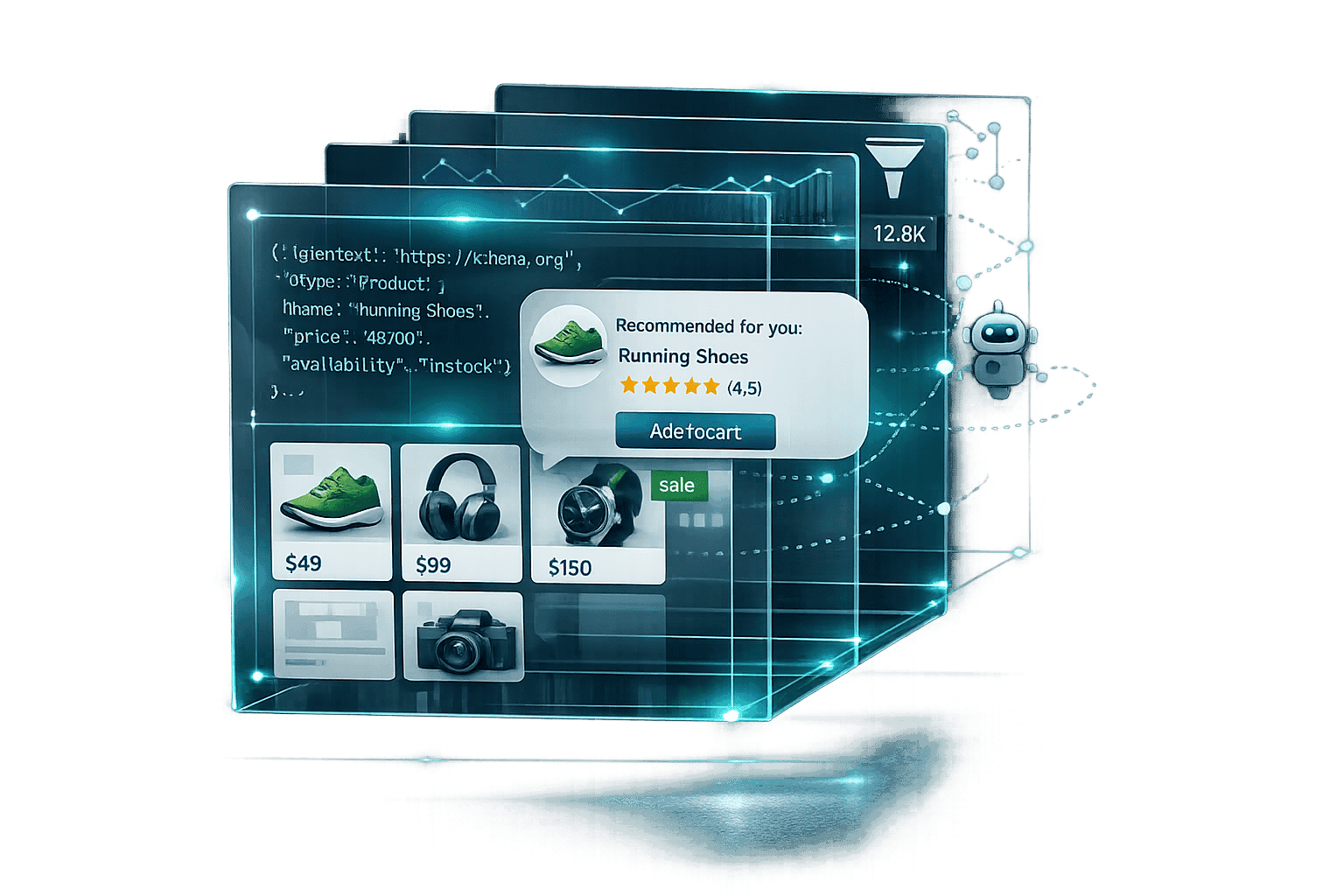
AI assistants like ChatGPT and Google Gemini are changing how people shop, with 33% of consumers ready to buy directly through them. By 2030, $3–$5 trillion in retail sales could flow through these platforms. But most Shopify stores aren’t ready - an analysis of 1,000 stores found an average AI Search Readiness score of just 42/100. The problem? AI prioritizes structured data and clear product details, not keywords or backlinks.
Here’s how to prepare your Shopify store for AI-driven discovery:
Structured Data: Use JSON-LD schema to make product info machine-readable.
AI-Friendly Content: Write product descriptions that answer conversational queries (e.g., "What’s the best cookware for induction stoves?").
Technical Setup: Ensure AI crawlers like GPTBot can access your site, and fix duplicate URLs.
Track Visibility: Test prompts on AI tools and monitor your "share of answer" to see if your brand is being recommended.
With AI systems acting as product advisors, visibility in their recommendations is critical for staying competitive.
How to Optimise Your Shopify Pages for SEO & AEO (AI Search Ready)
AI Search vs. Traditional SEO: What's Different
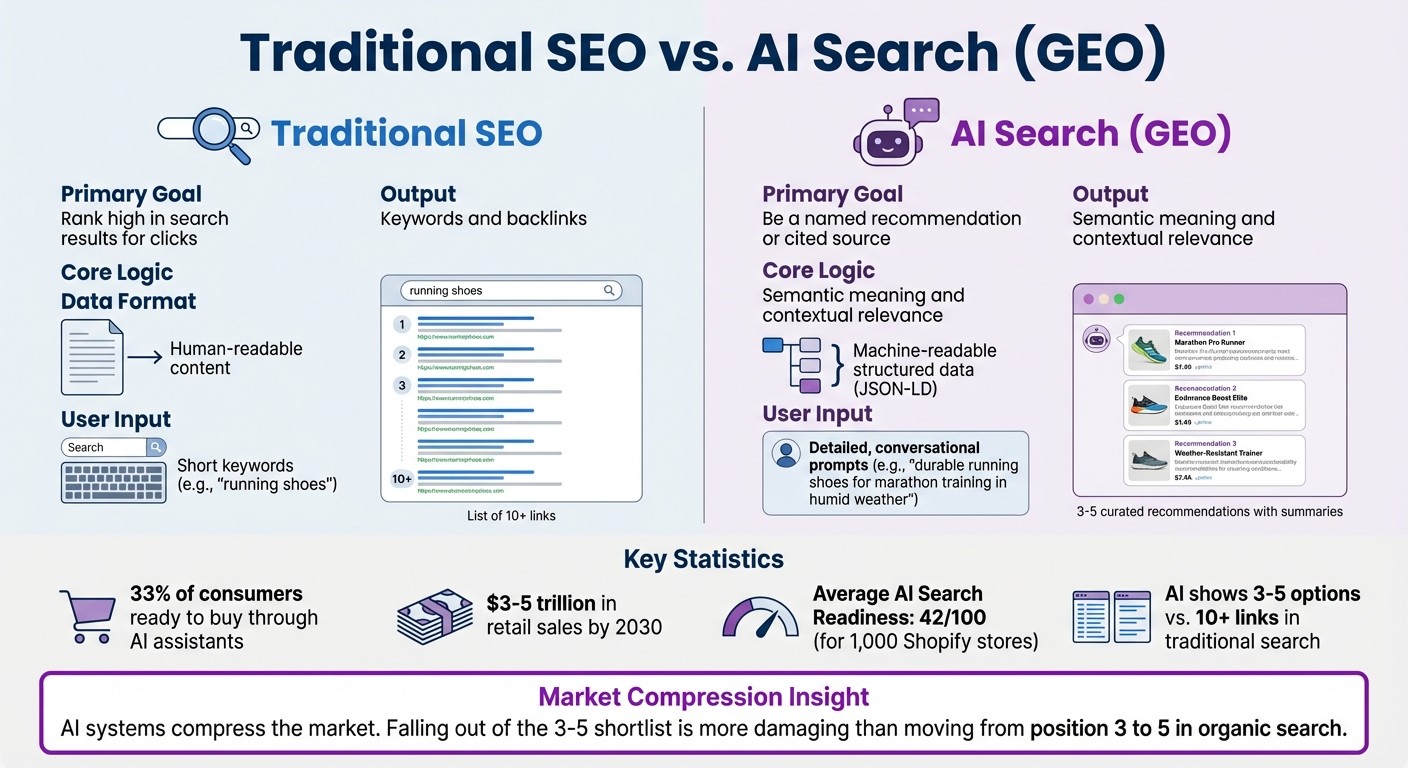
Traditional SEO vs AI Search (GEO): Key Differences for Shopify Stores
Traditional SEO focuses on ranking high in search results to attract human clicks, while AI search shifts the focus to machine decision-making using structured data. This change significantly affects whether Shopify merchants get recommended or overlooked.
For example, a Google search for "running shoes" generates a list of links ranked by keywords and backlinks. In contrast, asking ChatGPT or Perplexity for "durable running shoes for marathon training in humid weather" results in 3–5 specific recommendations, often with detailed explanations. As senso.ai explains:
"AI agents compress the market. Instead of showing 10 links, they often suggest 3–5 options. Falling out of that shortlist is more damaging than moving from position 3 to 5 in organic search" [6].
Traditional search engines rely on keywords and authority signals to rank pages. AI assistants, however, act as advanced comparison engines, analyzing product details, reviews, return policies, and inventory across numerous stores to provide the most reliable recommendations [6]. This requires ground truth - accurate, consistent, and machine-readable data.
Feature | Traditional SEO | AI Search (GEO) |
|---|---|---|
Primary Goal | Rank high in search results for clicks | Be a named recommendation or cited source |
Core Logic | Keywords and backlinks | Semantic meaning and contextual relevance |
Data Format | Human-readable content | Machine-readable structured data (JSON-LD) |
User Input | Short keywords | Detailed, conversational prompts |
Output | List of 10+ links | 3–5 curated recommendations with summaries |
This shift represents more than just a technical change - it’s a new business model. Traditional SEO drives traffic to your site, while AI search determines if your product is selected as the answer. Gentian Shero, Co-founder & CSO of Shero Commerce, highlights this:
"AI systems are not choosing a position on a results page. They are deciding whether your content is clear enough to use in an answer" [1].
Understanding these differences is crucial for adapting your product data to AI’s evolving standards.
How AI Search Works
AI search systems build knowledge graphs - interconnected networks of information drawn from your site (product pages, FAQs, blog posts) and external sources like Reddit, YouTube, and forums [8].
When an AI assistant receives a query like "I need breathable sheets for sensitive skin in humid climates", it breaks the request into structured attributes (e.g., material type, use case, environmental conditions). Using semantic understanding, it scans the knowledge graph to find matching products [5].
This method prioritizes context over keywords [5]. AI assistants evaluate structured data for details like thread count, fabric composition, hypoallergenic properties, and moisture-wicking capabilities. Without these attributes, your products can’t be considered. Clear, structured data boosts your chances of being recommended, as AI assistants increasingly act as the new storefront for ecommerce.
AI models are cautious by nature. They favor products with clear return policies, safety certifications, and strong reviews to avoid poor recommendations [6]. Inconsistent or incomplete data can disqualify your products entirely.
This context-driven approach forms the foundation of GEO, the strategy for aligning your Shopify store with AI’s requirements.
What is GEO (Generative Engine Optimization)?
GEO (Generative Engine Optimization) prepares Shopify stores to be recognized, understood, and recommended by AI systems like ChatGPT, Google Gemini, and Perplexity. While traditional SEO focuses on ranking for clicks, GEO ensures your product becomes a named recommendation or cited source in AI-generated answers [6].
The key difference lies in data structure. Traditional SEO relies on human-readable content, meta descriptions, and backlinks, while GEO depends on structured data formats like JSON-LD schema markup. For instance, schema replaces descriptive text with precise data points, such as "weight": "8.5 oz", "material": "mesh upper with carbon fiber plate", or "durability": "500+ miles" [6][4].
This requires a shift in content strategy. As the nopAccelerate team explains:
"Google ranks pages; AI interprets knowledge. Your foundation must serve both" [5].
To optimize for answerability, you’ll need question-style headings, structured FAQ sections, and product descriptions that focus on outcomes rather than features [8]. MentionOS emphasizes the importance of conversational commerce in this process.
GEO also extends beyond your website. AI systems gather insights from third-party mentions, such as Reddit discussions, YouTube reviews, and niche forums [2]. This process, called brand seeding, means your off-site presence is just as critical as your on-site data. Without visibility in AI-crawled spaces, even the most technically optimized product pages can go unnoticed.
A study of 1,000 Shopify stores revealed an average AI Search Readiness score of just 42 out of 100 [1]. Many merchants are unaware they’re being evaluated by AI systems. Those who adapt early will position themselves for the next wave of ecommerce growth.
How to Audit Your Shopify Store's AI Visibility
Before diving into optimization, it's crucial to audit your store's AI visibility. Many Shopify merchants might not realize that AI assistants are already analyzing their data. Without proper structure, these systems could end up recommending competitors instead. Since AI assistants are quickly becoming the go-to storefronts for ecommerce, ensuring your brand is visible to them is more important than ever. The audit process boils down to two main steps: tracking how often AI platforms mention your brand and pinpointing gaps that allow competitors to dominate recommendations. Unlike traditional SEO audits that focus on keyword rankings, these audits focus on whether your products are chosen as answers in conversational queries.
Track Your Brand Mentions on AI Platforms
To start, test how AI platforms like ChatGPT, Google Gemini, and Perplexity respond to customer-style queries in your category. For instance, you could try prompts like, "durable running shoes for marathon training in humid weather." Take note of whether your brand appears in the recommendations, and if not, which competitors are being highlighted.
While manual testing can uncover patterns, scaling this effort requires specialized tools. One option is MentionOS, which tracks brand mentions across platforms like ChatGPT, Perplexity, and Gemini. This tool provides insights into your "share of answer" - the percentage of relevant prompts where your brand is mentioned compared to competitors [5].
Another way to check is through Google Analytics 4. Look for referral traffic from sources like chatgpt.com or perplexity.ai to see if users are already finding your store via AI assistants [1].
Don’t overlook technical accessibility. Start by reviewing your robots.txt file to ensure you're not accidentally blocking AI crawlers like OAI-SearchBot (OpenAI), GPTBot, or PerplexityBot [2]. Additionally, use developer tools to disable JavaScript and confirm that essential product data - like price, description, and availability - renders in raw HTML. Many AI bots can't process JavaScript, so this step is crucial [2].
Once you’ve gathered this data, the next step is to figure out why competitors might be outperforming you.
Find AI Visibility Gaps and Competitor Advantages
Understanding why competitors are being recommended over your products is key. Often, the issue lies in missing or incomplete structured data. Tools like SEO Buddy (available for free on the Shopify App Store, rated 4.0/5 stars) can help you validate your JSON-LD schema to ensure fields like brand, GTIN, price, and availability are properly configured [13].
Compare your product pages with those of competitors who are being recommended by AI. Pay close attention to their structured attributes, such as material, dimensions, use case, and product type. As Atomz points out:
"Your data is syncing. But if it's marketing copy instead of structured attributes, AI can't match it to searches" [12].
AI assistants also weigh external signals to assess your store's trustworthiness. Check if your brand is mentioned on platforms like Reddit, YouTube reviews, niche forums, or industry blogs. These third-party references help build credibility.
Tools like Semrush's AI Visibility Toolkit can also be useful. Its "Brand & Marketing" section allows you to monitor sentiment around your brand and compare it to competitors [14]. This can help you identify which AI assistants are favoring your competition and why.
Lastly, review your Google Merchant Center feed. AI tools like Microsoft Copilot and ChatGPT heavily rely on these feeds for real-time data on pricing and availability. Errors or disapprovals in your Merchant Center feed can prevent your products from being recommended by AI assistants [3]. Following these audit steps will better position your brand for AI-driven recommendations, giving you an edge in conversational commerce.
How to Optimize Your Shopify Store for AI Search
Now that you’ve assessed your store’s current standing, it’s time to make the adjustments that will help AI identify and recommend your store. Optimizing for AI involves three key areas: structuring your product data so it’s easy for AI to interpret, creating content that aligns with how people phrase their shopping questions, and ensuring AI crawlers can easily access your site. Unlike traditional SEO, where the goal is ranking higher, AI optimization focuses on making your store clear and credible enough for AI to confidently recommend. Here’s a closer look at how to achieve this.
Optimize Product Data and Structured Information
Your audit should have highlighted where your product data needs work, and this is where structured information becomes essential. AI assistants can’t recommend products they don’t understand. The shift from keyword-based SEO to semantic SEO means your product data needs to convey meaning, not just match terms. Gentian Shero, Co-founder of Shero Commerce, explains:
"If your content is not structured in a way that AI can understand, most likely you won't show up, even if your product is a perfect match" [8].
For example, keep product titles concise - under 70 characters - and include the product type, brand, and a key feature or benefit. Instead of a vague title like "Eco Pan", go for something like "10-Inch Ceramic Frying Pan – Non-Toxic, PFAS-Free" [8][4]. This gives AI enough context to match your product with specific queries, such as "non-toxic cookware for induction stoves."
Next, implement JSON-LD markup to cover schemas for Product, Offer, Review, and FAQ. Microsoft emphasizes that structured data helps search engines index your content accurately and display it effectively in search results, shopping tools, and AI-driven assistants [2].
Ensure your product data is rendered in raw HTML rather than JavaScript, as many AI crawlers don’t process JavaScript [2]. Additionally, use Shopify webhooks to keep product feeds up-to-date. AI tools penalize stores with outdated inventory or inconsistent pricing [4][9].
Create AI-Optimized Content for Product Pages
Your product pages should be designed to answer the kinds of conversational questions people now ask AI tools. With over 50% of consumers using AI for product discovery, they’re asking questions like, "What are the best breathable sheets for hot sleepers with sensitive skin?" rather than typing simple keywords [15][2].
Start your product pages with a brief summary that outlines the product, its target audience, and its main benefit [8][1]. This provides AI with a clear snippet to quote.
Use bullet points to focus on outcomes rather than technical details. For instance, instead of writing "moisture-wicking synthetic upper", say "Keeps your feet dry during long runs" [8][1].
Add a Q&A section to every product page to address common questions or objections. Use question-style headings like "Is this cookware safe for induction stoves?" and mark up these sections with FAQ schema to make them AI-friendly [8][15]. Since 47% of shoppers rely on AI for product recommendations, this step is critical [9].
Don’t overlook your collection pages - they’re often under-optimized for AI, with an average readiness score of just 35 out of 100 [1]. Add brief introductory paragraphs and use question-style headings to provide context. Including sections like "Who this is for" or comparison tables can help AI agents better match your products to specific consumer needs [15][3].
Set Up Technical SEO for AI Crawlers
Once your product data and content are optimized, the final step is ensuring AI crawlers can access your site seamlessly. Start by updating your robots.txt file to allow AI bots, such as oai-searchbot (ChatGPT), GPTBot (OpenAI training), PerplexityBot, and ClaudeBot [8][2]. As Backlinko points out:
"If you block the crawler, it won't be able to serve your pages in its responses" [2].
Create an llms.txt file in your root directory (e.g., yoursite.com/llms.txt). This file acts as a sitemap specifically for large language models (LLMs), including your brand description and links to key categories and top products [8].
Address Shopify’s default duplicate URL issue. Products are often accessible through multiple paths, such as /collections/summer/products/tshirt and /products/tshirt. This can confuse AI crawlers and dilute your authority. Update your theme files so all internal links point to the canonical /products/product-name URL [7].
Finally, improve your site’s load time. A 0.1-second improvement can increase conversions by over 10% [7]. AI systems use Core Web Vitals as a trust signal, so optimize your images with WebP formats and enable lazy loading for content below the fold [7][4].
For those serious about AI visibility, consider applying to programs like OpenAI’s Product Discovery program and the Perplexity Merchant Program. These initiatives let you provide direct product data feeds to AI platforms, giving your store a competitive edge. With 33% of consumers already open to making purchases via AI agents, this could position your store for future success [3].
How to Measure and Improve AI Search Performance
Data is the backbone of improving AI visibility. In today’s world, where AI assistants often serve as the digital storefront for your brand, it’s vital to track and refine how your store appears in AI-generated recommendations. Unlike traditional SEO, where you can directly monitor your Google ranking, AI visibility is less predictable. Your brand might show up in one AI response but not in another, depending on how the question is phrased [2][5]. This makes consistent tracking a must.
Track AI Mentions and Recommendations
Start by creating a Prompt Library - a collection of 20–30 questions your customers might ask AI tools, grouped by topics and personas. For example, you could test prompts like, “What are the best non-toxic frying pans for induction stoves?” or “Which cookware brands are family-friendly?” Run these prompts monthly on platforms like ChatGPT, Perplexity, and Gemini to see how often your brand appears and what descriptions are provided [18].
The key metric to monitor is your Brand Visibility Score, which measures how often your brand is mentioned in responses. As AirOps puts it:
"Brand Visibility Score - answers mentioning your brand divided by total relevant answers - is now the North Star metric for AI search" [18].
For instance, if your brand is mentioned in 8 out of 20 relevant responses, your visibility score would be 40%. Beyond just mentions, pay attention to citation quality - whether the AI simply references your brand or directly quotes your content. Brands that earn both mentions and citations are 40% more likely to sustain visibility over time [18].
Shopify merchants can take advantage of built-in tools like ShopifyQL to track AI-driven traffic. For instance, you can create custom reports to filter sessions from AI sources like referrer_name IN ('openai', 'chatgpt', 'perplexity', 'gemini', 'copilot'), segmented by month [17]. Similarly, in Google Analytics 4, you can set up custom channel groups to differentiate AI-driven sessions from other referral traffic [18].
For more advanced tracking, consider tools like Otterly.AI ($25/month), ZipTie ($58.65/month), or Profound ($82.50/month). These platforms monitor brand mentions across various AI models, identify citation sources, and provide metrics like "AI Success Scores" with sentiment analysis [16]. These insights will help you refine your strategy effectively.
Use Performance Data to Refine Your Strategy
Once you’ve established baseline metrics, use the data to pinpoint areas for improvement. Look for trends that highlight where your efforts should go. For example, if AI tools are citing third-party platforms like Reddit or Quora instead of your Shopify store, it might be time to focus on digital PR or community engagement to strengthen your online presence [14]. If your visibility score is strong in one product category but weak in another, review the weaker category’s structured data or Q&A content to find and fill any gaps [18].
Another critical metric is your Share of Answer - how often your brand appears compared to competitors for valuable prompts. If competitors frequently show up alongside your brand, analyze their product pages and adjust your own strategy accordingly [18].
Don’t forget to monitor bot crawl activity in your server logs. Look for traffic from GPTBot, OAI-SearchBot, and PerplexityBot to ensure AI crawlers are accessing your content. If you notice a drop in crawl frequency, it could signal issues like blocked bots or JavaScript rendering problems [2].
Lastly, keep an eye on indirect signs of AI-driven discovery. While you might not see an immediate surge in referral traffic, you could notice increases in branded search volume, direct website visits, or email signups as customers return after discovering your brand through AI [1]. Tracking these secondary metrics will give you a more complete view of how AI visibility contributes to your growth.
Conclusion
AI assistants are transforming how consumers discover and purchase products. Between November and December 2024, U.S. retail websites saw a staggering 1,300% surge in traffic from generative AI searches compared to the previous year [11]. This shift highlights just how crucial it is for businesses to adapt to AI-driven commerce.
Gentian Shero, Co-founder & CSO of Shero Commerce, captures this perfectly:
"By 2026, clarity will be a competitive advantage. Not because AI replaces search, but because discovery increasingly happens before it." [1]
To stay ahead, businesses need to focus on key areas: use structured schema markup, optimize for conversational queries, ensure sub-2.5 second load speeds, and make product data machine-readable [10][19]. It’s equally important to monitor visibility on platforms like ChatGPT, Perplexity, and Gemini, as many Shopify stores currently fall short of readiness [1].
Jason Jackson, Lead Technical SEO Strategist at Codal, emphasizes the urgency:
"The competitive window spans six to 12 months... Brands that invest in their product data foundations today will accumulate advantages that compound." [3]
McKinsey predicts that $3–$5 trillion in global retail could flow through agent commerce by 2030 [3]. The question isn’t whether AI-driven discovery will matter - it’s whether your store will be visible when it does.
As AI assistants take center stage as the new storefronts, tools like MentionOS become essential. For $29/month, MentionOS helps brands track mentions, spot visibility gaps, and publish AI-optimized content directly from Shopify. This approach ensures your products are front and center when customers ask, "What should I buy?"
FAQs
What structured data fields matter most for AI recommendations?
Structured data fields play a crucial role in improving how AI interprets and displays your content. Key fields to focus on include:
Product title: Ensure it's clear and concise.
Description: Provide detailed and accurate information about the product.
Brand: Specify the manufacturer or brand name.
GTIN/MPN: Include unique identifiers like the Global Trade Item Number or Manufacturer Part Number.
Color and size: Offer specifics, especially for products with variations.
Images: Use high-quality visuals that represent the product accurately.
Price and currency: Clearly state the cost and the associated currency.
Availability: Indicate if the product is in stock or when it will be restocked.
Sale prices with valid dates: Highlight discounts and their timeframes.
Review or rating information: Incorporate customer feedback to build credibility.
These fields not only boost visibility in AI-powered search results but also strengthen trust with potential customers.
How do I know if AI bots can crawl my Shopify product pages?
To ensure AI bots can effectively crawl your Shopify product pages, make sure your product data is formatted with structured, machine-readable markup like JSON-LD. Include key details such as the title, description, price, availability, and reviews. You can use tools like Google's Rich Results Test to confirm that your pages are correctly optimized for AI systems.
What should I track to measure “AI visibility” for my store?
To gauge "AI visibility" for your store, pay attention to key metrics such as product discoverability in AI search results, the accuracy of your structured data, and the frequency and quality of AI-driven customer interactions. These factors provide valuable insights into how effectively your store aligns with AI algorithms, ultimately enhancing recommendations and customer experiences.
Related Blog Posts
Don’t let AI decide your visibility without you
AI search and chat tools are shaping what customers discover. MentionOS gives you clarity, insight, and control over how your brand is recommended.