Download App
What Is AI Visibility and Why It Matters for Sales
E-Commerce SEO
Feb 12, 2026
Learn why AI visibility determines which products AI assistants recommend, and how Shopify stores can use structured data, content, and tracking to boost sales.

AI visibility is all about ensuring your brand or product gets mentioned in responses generated by AI platforms like ChatGPT, Google Gemini, and Claude. Instead of competing for a spot on a search engine results page, you're vying to be part of a single, synthesized answer. If your product isn’t included in that response, you’re effectively invisible to potential buyers.
Here’s why it matters:
AI assistants are the new storefronts: Almost 50% of Gen Z shoppers use AI tools for product discovery.
Higher conversion rates: Traffic from AI recommendations converts 4.4x better than traditional search.
Technical challenges for Shopify stores: Many stores lack the structured data needed for AI to recognize their products.
Key steps to improve AI visibility:
Implement structured data (e.g., JSON-LD, Schema.org).
Ensure product information is consistent across platforms.
Optimize content for specific, high-intent user queries.
Track AI mentions using tools like MentionOS to identify gaps.
If your store isn’t visible to AI, you’re missing out on being part of the AI-curated shortlists that drive purchasing decisions.
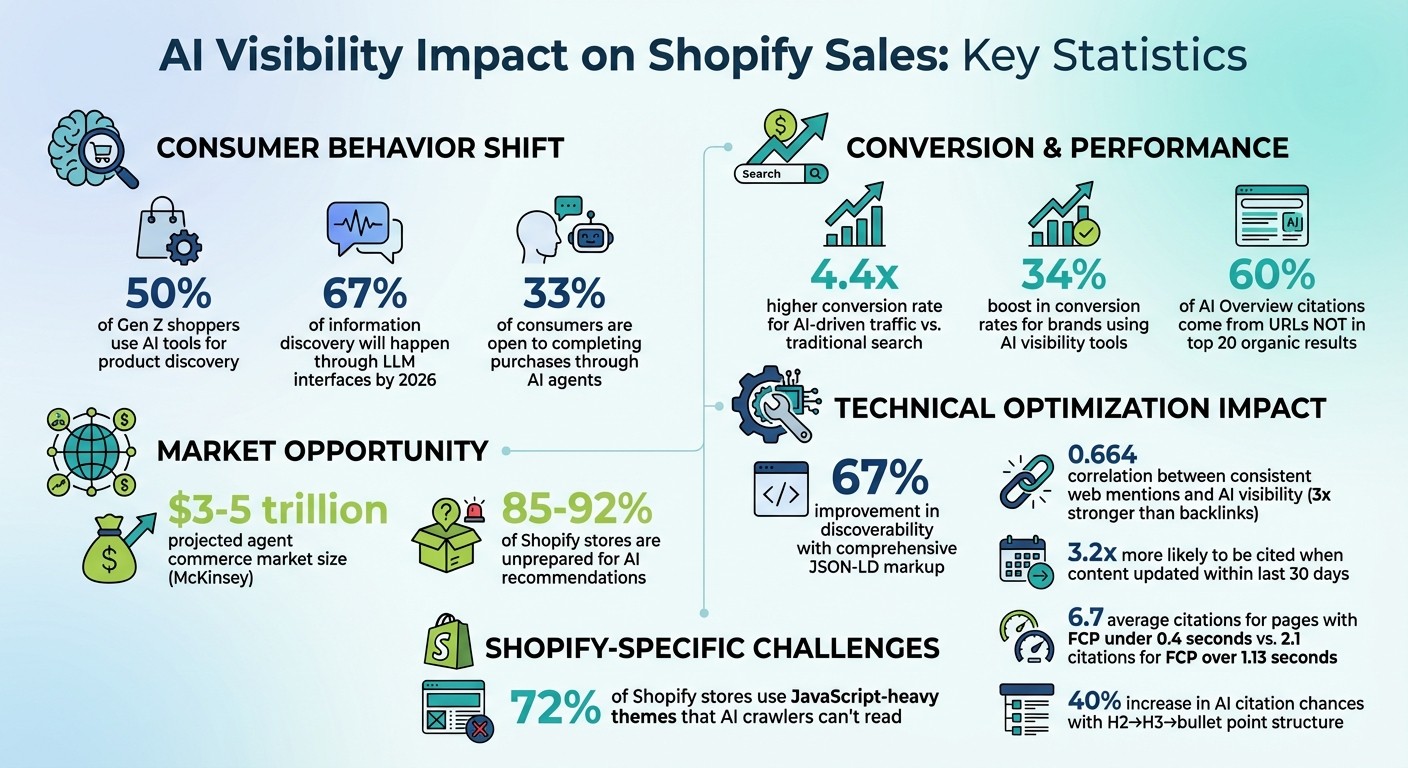
AI Visibility Impact on Shopify Sales: Key Statistics and Performance Metrics
Why AI Visibility Drives Sales
How AI Recommendations Affect Purchase Behavior
AI assistants have transformed how consumers shop by significantly shortening the research process. For instance, a query like “What’s the best quiet dishwasher under $1,000?” on ChatGPT delivers a concise, curated list of options. This means buyers can move from initial inquiry to making a purchase in just minutes[4].
The numbers back this up. Traffic driven by AI recommendations converts at 4.4 times the rate of traditional search traffic[8]. Why? Because these shoppers come prepared. AI tools have already done the heavy lifting - filtering choices, comparing specs, and validating claims using reputable review sources. By the time buyers land on your site, they’re confident and ready to make a decision[7].
Trust plays a huge role here. When AI platforms include your product alongside trusted review sites or industry benchmarks, it provides the kind of independent validation that reassures even the most cautious shoppers[4]. This seamless, confidence-boosting experience sets AI-driven shopping apart from traditional methods, where uncertainty and extensive research often delay purchases.
The Cost of Being Invisible to AI
Failing to appear in AI-generated recommendations is a costly mistake. For brands, it means losing out on traffic and missing a chance to be part of the AI-curated shortlists that guide so many buying decisions. With nearly 50% of Gen Z now using ChatGPT for product discovery, invisibility in these spaces equals irrelevance[1].
The stakes couldn’t be higher. According to McKinsey, the agent commerce market is projected to hit $3–5 trillion, and without optimized, structured product data, Shopify brands risk being excluded entirely[6]. Already, 33% of consumers are open to completing purchases through AI agents[6].
"The question isn't whether agent commerce will matter. It's whether your store will be visible when it does." - Jason Jackson, Lead Technical SEO Strategist, Codal[6]
Technical hurdles only make this problem worse. Many Shopify themes rely heavily on JavaScript, which can appear blank to AI crawlers. Without proper schema markup or consistent identifiers like SKUs or GTINs, AI engines might skip over your brand altogether[1][4]. To stay competitive in this fast-evolving landscape, ensuring your products are visible to AI isn’t just smart - it’s essential.
How AI Visibility Works for Shopify Brands

Key Components of AI Visibility
AI visibility depends on several factors that dictate whether your brand appears in AI-generated recommendations. The first key element is Presence - ensuring that platforms like ChatGPT or Perplexity can locate and display your products. The second is credibility, which relies on consistent, verifiable signals across the web. Interestingly, consistent web mentions correlate with a 0.664 increase in AI visibility, a stronger effect than traditional backlink metrics[2].
For Shopify brands, these factors come with unique challenges tied to the platform’s structure and limitations.
Shopify-Specific Visibility Factors
Shopify stores face technical hurdles that many merchants might not even realize. For instance, 72% of Shopify stores use JavaScript-heavy themes. Since AI crawlers primarily read raw HTML, content that loads only after JavaScript execution - like product descriptions, specifications, or pricing - remains invisible to these systems[1]. In essence, if the crawler can’t see it, neither can the AI assistant.
Another issue is Shopify’s rigid URL structure. The platform generates duplicate URLs for the same product (e.g., clean URLs versus collection-specific paths). This duplication weakens authority signals, which AI crawlers use to assess the relevance of your content[3]. Additionally, Shopify doesn’t allow merchants to host an llms.txt file in the root domain - a critical tool for directing AI crawlers to your most important pages[3].
To navigate these challenges, structured data becomes indispensable. Implementing comprehensive JSON-LD markup for Product, Offer, and FAQ schemas can improve discoverability by 67%[2]. Equally important is maintaining entity consistency across platforms. Your brand name, GTIN, and SKU must match exactly across your Shopify backend, Google Merchant Center, and any marketplaces where your products are listed. If these identifiers don’t align, AI engines may hesitate to recommend your products[4]. Additionally, granting access to AI crawlers like OAI-SearchBot via your robots.txt file is essential for ensuring product pages are accessible[5].
These technical issues directly influence how AI assistants discover and recommend your products. Addressing them is critical for brands relying on AI-driven visibility.
AI Requirement | Native Shopify Limitation | Impact |
|---|---|---|
Crawler Control | Limited | Harder to optimize for specific AI bots |
Proactive Guidance | No native | Invisible to non-Google AI systems |
Unambiguous Data | Incomplete/Basic Schema | AI struggles to interpret product variants |
URL Clarity | Rigid/Duplicate URL paths | Weakens authority for individual products |
Performance also plays a huge role. Pages with a First Contentful Paint (FCP) under 0.4 seconds average 6.7 citations, compared to just 2.1 citations for FCPs over 1.13 seconds[2]. Keeping your content updated is equally important. Pages updated within the last 30 days see a 3.2x boost in AI citations[2]. This highlights the need to not only optimize site speed but also ensure your product data, descriptions, and prices are always current. AI engines evaluate your catalog multiple times a day, so staying ahead is essential for Shopify brands.
How to Improve AI Visibility on Shopify
Use Structured Data and Schema Markup
Structured data acts as a direct communication channel with AI systems. By implementing JSON‑LD markup, you make it easier for large language models to confidently recommend your products.
Since the Universal Commerce Protocol became part of Shopify's native configuration in January 2026, data quality has become a key factor in standing out from competitors[6]. To get ahead, include complete schemas for Product, Offer, and AggregateRating, along with FAQPage and nested Organization details for policies like returns and warranties[9][10][4][6][12].
Consistency is critical when it comes to standardized identifiers like GTIN, MPN, and SKU. These identifiers must match perfectly across your Shopify backend, Google Merchant Center, and any marketplaces. For example, if your product is listed as weighing 10.2 oz on your Shopify page but 9.9 oz on Amazon, AI systems may skip over your brand entirely due to conflicting data[11][4]. Additionally, make sure your robots.txt file allows OAI-SearchBot to crawl your product pages and structured data[12].
Once your structured data is in place, the next step is to focus on creating content that directly answers user queries.
Optimize Content for High-Intent Queries
AI systems are designed to provide answers, not just detect keywords[3]. That means your product descriptions should feel conversational and natural. For example, instead of generic phrases like "premium running footwear", focus on addressing specific questions like, "What are the best running shoes for wide feet?" Structure your answers with a concise response (40–80 words) followed by a more detailed explanation (150–250 words)[4].
Use headers that reflect common user questions, such as "What makes this backpack waterproof?" or "Is this product good for flat feet?"[9][8]. AI-driven search visitors are 4.4x more likely to convert compared to traditional organic search visitors because they’ve already been filtered through conversational queries[13]. Updating your content regularly also helps - content refreshed within the last 30 days is 3.2x more likely to be cited by AI systems. Structuring your content with an H2 → H3 → bullet point format increases your chances of AI citation by 40%[2].
Comparison tables are another effective tool. They make it easy for AI to parse product trade-offs, helping users make decisions faster[2][4]. Optimize your meta titles with specific attributes like "70L Women's Hiking Backpack" to capture high-intent queries[8]. The goal isn’t just to rank for keywords anymore - it’s to ensure your brand is named in AI-generated answers.
These efforts naturally lead to tracking your AI mentions, an essential step in improving visibility further.
Track and Improve AI Mentions
After implementing structured data and optimizing your content, tracking how AI platforms mention your brand can directly impact your sales. Research shows that brand mentions have a 0.664 correlation with AI visibility - almost three times stronger than traditional backlinks[14][2]. Without monitoring how AI refers to your brand, you’re missing key opportunities. Key metrics to track include Share of Citation (how often your brand is mentioned compared to competitors), Mentioned Queries (the number of prompts that surface your brand), and Citation Quality Score (whether your brand is highlighted as "best" or simply an "alternative")[4].
Tools like MentionOS can help you track your brand’s mentions across platforms like ChatGPT, Perplexity, and Gemini. These tools identify gaps in visibility and show which queries lead users to your competitors instead. MentionOS also offers features like AI Store Optimization and Content Studio for AI, making it easier to create content that AI crawlers can access. Plans start at $29/month for individuals tracking 5 prompts, with options scaling up to $79/month for organizations monitoring 100 prompts with API access.
Building a strong presence on platforms like Reddit and Quora can also boost your AI citations by four times[14]. Encourage customers to leave reviews that highlight specific use cases, such as "best for wide feet", to enrich the semantic data AI systems retrieve[8]. As Jason Jackson, Lead Technical SEO Strategist at Codal, puts it:
"The only remaining competitive differentiator is how well your product information is structured for machine consumption." [6]
How MentionOS Improves AI Visibility for Shopify Brands
MentionOS: The AI Visibility Platform for Shopify
Shopify brands aiming to stay relevant in an AI-driven world now have a tailored solution: MentionOS. As AI assistants become the go-to for product discovery, MentionOS ensures that Shopify merchants can secure a spot in AI-generated recommendations.
Unlike traditional SEO tools that focus on Google rankings, MentionOS takes a different approach. It tracks real user interactions with AI platforms like ChatGPT, Perplexity, and Gemini using a privacy-focused browser extension. This extension logs user queries and identifies which brands are being recommended by these AI systems[16].
This method uncovers gaps that automated simulations often overlook. For instance, if someone asks, "What are the best running shoes for wide feet for marathon training?" and your brand doesn’t appear, MentionOS pinpoints why competitors are being mentioned instead. The platform also calculates a Share of Voice metric, showing how your brand stacks up against competitors across major AI platforms[16].
Next up, let’s dive into the features that make this tool essential for AI visibility.
MentionOS Features and Benefits
MentionOS focuses on four main features to make AI-driven commerce measurable.
AI Visibility Tracking: This feature monitors where your brand appears in responses from AI platforms like ChatGPT, Perplexity, Gemini, and Google AI.
Sentiment Analysis: It evaluates the tone and context of mentions, helping you understand if AI positions your brand as a top choice or just an alternative.
Content Studio for AI: This tool creates optimized product descriptions and articles tailored for AI systems, ensuring your brand is more likely to be referenced.
AI Store Optimization: By implementing technical upgrades like structured data and llms.txt customization, this feature makes your Shopify store more AI-friendly.
Research indicates that brands need around 250 documents across the web to influence how large language models (LLMs) describe them[15]. MentionOS simplifies this process, cutting the manual effort from 547 hours to just 12 hours per year[17].
These features are available through flexible pricing plans to accommodate businesses at different stages of growth.
MentionOS Pricing and Plans
MentionOS offers three pricing tiers to suit Shopify brands of varying sizes:
Plan | Price | Tracked Prompts | AI Articles/Month | Best For |
|---|---|---|---|---|
Starter | $29/month | 5 | 5 | Brands under $10K monthly revenue |
Growth | $49/month | 50 | 20 | Brands earning $10K–$100K monthly |
Professional | $79/month | 100 | 30 | Brands over $100K monthly revenue |
All plans include unlimited competitor tracking, historical data access, and support for AI platforms like ChatGPT, Perplexity, and Gemini.
Brands that adopt AI visibility tools often see a 34% boost in conversion rates, directly impacting revenue in a market where being overlooked by AI can mean losing sales[17]. For those unsure of their current AI visibility, MentionOS offers a free audit at mention.network, giving merchants insights into how they’re performing in AI-driven recommendations before committing to a paid plan[16].
How to Make Your Shopify Store Visible in AI Search Results
Conclusion
The rise of AI assistants is reshaping how consumers discover products. By 2026, 67% of information discovery will happen through LLM interfaces[2], and nearly half of Gen Z shoppers are already turning to ChatGPT for product searches[1]. Despite this shift, 85–92% of Shopify stores remain unprepared to appear in AI-driven recommendations[1], leaving a significant opportunity for brands willing to adapt.
"The future of competition isn't about ranking for keywords... It's about being the brand AI systems trust enough to recommend when your customer asks for help." - Adam Edwards & Travis Tallent, Brainlabs[18]
Traditional SEO strategies are no longer enough. A surprising 60% of AI Overview citations come from URLs that don't rank in the top 20 organic results[19]. To stay relevant, brands must focus on structured data and consistent identifiers to align their stores with AI priorities. The goal isn’t just about matching keywords - it’s about becoming a trusted source that AI systems rely on for authoritative answers.
If your Shopify store isn’t optimized for AI visibility, you risk being overlooked at the critical moment when buyers are ready to make a purchase. By embracing AI-driven recommendations and tools like MentionOS, your brand can lead the way in conversational commerce, ensuring it remains part of the shortlist and captures sales in this rapidly evolving landscape.
FAQs
How do I know if AI assistants recommend my products?
To ensure AI assistants recommend your products, make sure your store is set up for AI search and recommendations. Start by providing detailed, well-organized product information. Additionally, keep an eye on how visible your store is on AI-powered platforms like ChatGPT. Many businesses miss out because they aren't optimized properly, so improving your store's discoverability through AI can help you stay ahead of the competition.
What Shopify fixes help AI crawlers see my product pages?
To make your Shopify store more visible to AI crawlers, focus on three key areas:
Use complete schema.org structured data: This helps crawlers understand your product details, like pricing, availability, and descriptions, making it easier for platforms to display your products accurately.
Provide clear and factual content: Ensure your product pages are well-written and informative so both users and AI can easily interpret the information.
Configure your robots.txt file correctly: Allow AI crawlers access to your site by properly setting up your robots.txt file. This ensures platforms can discover and recommend your products without restrictions.
These steps can help AI-driven platforms identify and highlight your products more effectively.
Which product data matters most for AI recommendations?
The most important product data for AI recommendations includes clean, well-structured product feeds, accurate GTINs (Global Trade Item Numbers), detailed product descriptions, customer reviews, pricing information, and clear policies. These components allow AI systems to effectively identify, analyze, and recommend your products to the right audience.
Related Blog Posts
Don’t let AI decide your visibility without you
AI search and chat tools are shaping what customers discover. MentionOS gives you clarity, insight, and control over how your brand is recommended.