Download App
7 Ways AI Recommendations Impact E-commerce Sales
E-Commerce SEO
Feb 11, 2026
AI recommendations increase conversions and AOV, reduce cart abandonment, speed product discovery, and strengthen customer loyalty for Shopify and other e-commerce stores.
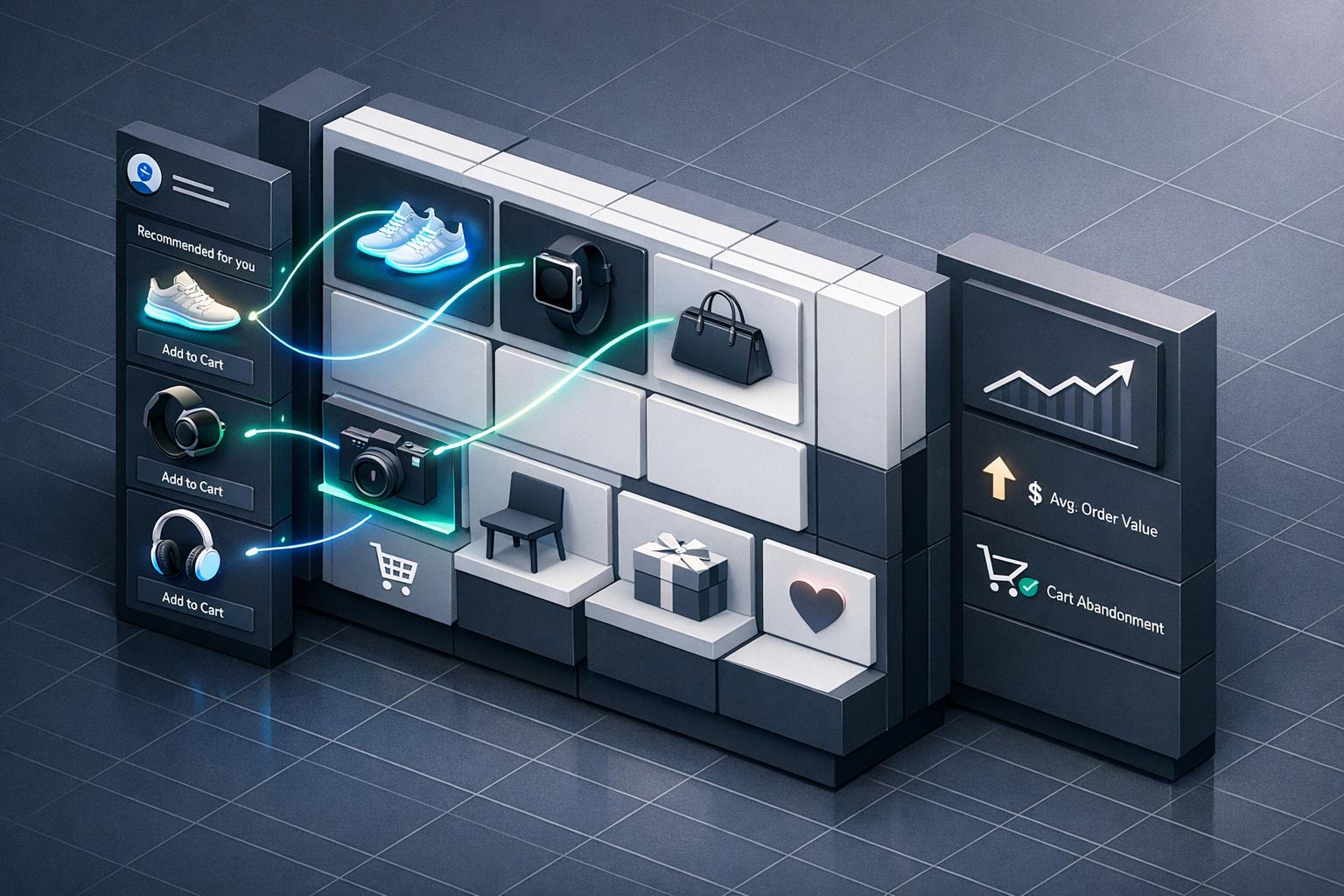
AI-driven recommendations are transforming e-commerce by personalizing shopping experiences, improving conversions, and increasing revenue. Here's the quick takeaway:
31% of e-commerce revenue comes from product recommendations.
Personalization boosts conversion rates by 10–15% and increases average order value by 33%.
56% of customers are more likely to return after a tailored shopping experience.
AI helps reduce cart abandonment, speeds up purchase decisions, and enhances customer loyalty.
For Shopify store owners, integrating AI tools like recommendation engines, upselling widgets, and chatbots is no longer optional - it’s essential to stay competitive in 2026. Below are the 7 key ways AI is reshaping e-commerce:
Higher Conversion Rates: Personalized product suggestions increase conversions by up to 15%.
Increased Order Value: Upselling and cross-selling raise spending by 33%.
Lower Cart Abandonment: AI recovers up to 15% of lost sales by addressing customer hesitations.
More Engagement: Shoppers spend 344% more time on sites with AI recommendations.
Better Inventory Management: AI promotes overstocked items and prevents stockouts.
Faster Product Discovery: AI highlights new items, driving quicker adoption.
Stronger Customer Loyalty: Tailored experiences create lasting relationships.
AI is now central to the e-commerce shopping journey, from discovery to checkout. Brands that leverage these tools effectively can boost revenue, retain customers, and thrive in a competitive landscape.
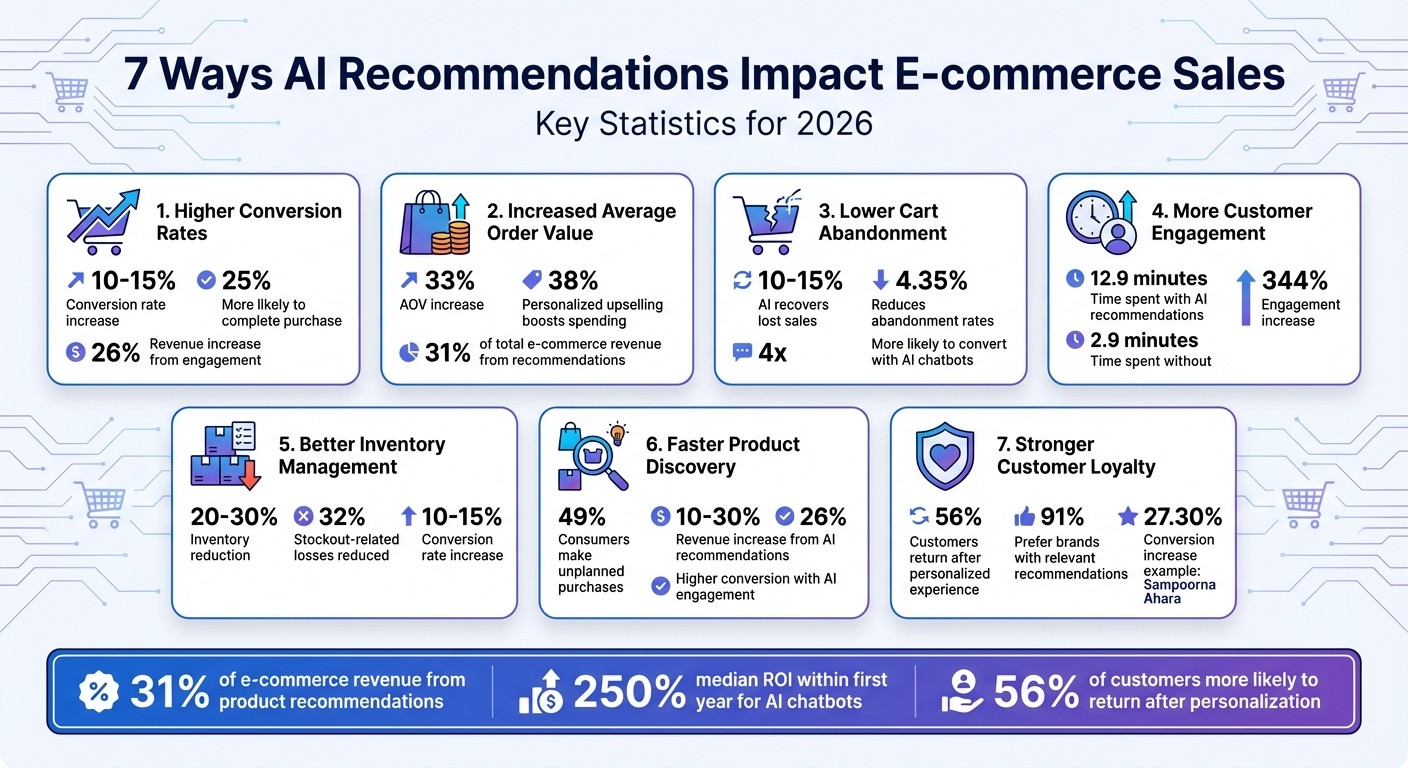
7 Ways AI Recommendations Impact E-commerce Sales: Key Statistics
1. Higher Conversion Rates Through Better Product Matching
Impact on Sales Metrics
AI recommendation systems use data like demographics, browsing behavior, and purchase history to suggest the perfect products for each customer [1]. This level of personalization can boost conversion rates by 10–15% and make shoppers 25% more likely to complete a purchase [2][9]. Visits where customers engage with recommendations see a 26% revenue increase [4], and AI-powered tools improve click-through rates to the next step by 40% [9]. These numbers highlight how AI can turn casual browsers into committed buyers.
Beyond driving sales, these systems also enhance the shopping experience, making it easier for customers to find what they need.
Customer Experience Enhancement
AI simplifies decision-making by offering tailored suggestions that align with customer preferences [1][9]. Shopify's AI tools, for instance, excel at helping first-time visitors by using conversational queries - no login or detailed profile required [3]. Shoppers who interact with AI recommendations spend an average of 12.9 minutes on a site, compared to just 2.9 minutes for those who don't [4]. Plus, personalization has a lasting impact: 56% of customers are more likely to return after enjoying a customized shopping experience [1][4]. In this way, AI goes beyond simple product matching, creating a more engaging and enjoyable shopping journey.
Practical Application in E-Commerce Platforms Like Shopify

AI can transform your entire storefront by integrating recommendations at every stage of the shopping process. For example, adding "Frequently Bought Together" widgets on product pages encourages cross-selling, while cart drawer upsells suggest complementary items just before checkout [1][2][4]. AI-powered search tools can also handle typos and vague queries, turning frustrating searches into successful product discoveries [3][8]. By strategically deploying AI across your Shopify store, you can create a seamless, data-driven shopping experience that boosts both engagement and sales.
2. Increased Average Order Value with Upselling and Cross-Selling
Impact on Sales Metrics
Using AI for upselling and cross-selling can significantly impact your revenue by encouraging customers to purchase additional items. Today, product recommendations contribute to 31% of total e-commerce revenues [4], and AI-driven systems have been shown to raise the average order value (AOV) by 33% [10]. Personalized upselling can push customer spending even further, increasing it by 38% - all without the added expense of acquiring new customers [8]. Considering that selling to existing customers is 5 to 25 times cheaper than attracting new ones [13], AI-powered recommendations stand out as one of the most efficient ways to grow your business. These numbers highlight the potential for Shopify and other platforms to leverage this strategy effectively.
Practical Application in E-Commerce Platforms Like Shopify
To maximize AOV, integrate AI recommendations at key touchpoints in the shopping journey. For example, cart drawer upsells and post-purchase offers are proven methods to increase cart totals [4]. Real-world success stories include Nabhi Sutra, which implemented personalized recommendations on Shopify in 2021 and saw a 15% increase in AOV [4]. Similarly, Dive Bomb Industries added post-purchase upsells and achieved a 12% boost in total sales [4].
One critical tip: stick to the 25% Rule - don’t suggest additional products that raise the order value by more than 25%, as this can deter customers with "sticker shock" [12]. By aligning upselling and cross-selling strategies with AI-powered tools, Shopify brands can stay ahead in the competitive e-commerce space. Companies like MentionOS are already leading the way in conversational commerce, helping businesses optimize their AI-driven product discovery.
Measurable Benefits for Businesses
The financial upside of AI recommendations is undeniable. Cross-selling alone can increase sales by up to 20% and boost profits by 30% [13]. Businesses using AI chatbots for product recommendations report a 250% median ROI within the first year [11]. Even incorporating AI-driven product suggestions in marketing emails can raise AOV by 50% [10]. When you combine these higher cart values with improved customer loyalty, AI recommendations become a must-have for long-term growth. This combination of cost efficiency and measurable results makes AI-based upselling and cross-selling an essential strategy for modern e-commerce.
3. Lower Cart Abandonment and Faster Purchase Decisions
Impact on Sales Metrics
Cart abandonment is a major issue for Shopify stores, with 70.2% of carts never reaching checkout. On mobile devices, this figure climbs even higher to 85.6% [15]. One of the biggest culprits? Unexpected shipping and tax costs, which account for 48% of these abandonments [15]. AI recommendation systems tackle this challenge head-on by analyzing real-time behavioral signals - like pauses during checkout, cursor movements toward the exit button, or repeated visits to the same page. These systems then intervene immediately to keep shoppers engaged [14][15]. The results? AI-powered cart recovery can reclaim 10–15% of lost sales, while personalized recommendations reduce abandonment rates by as much as 4.35% [4][19].
Practical Application in E-Commerce Platforms Like Shopify
AI doesn't just prevent abandonment; it speeds up purchase decisions. For instance, in 2024, Victoria Beckham introduced an AI stylist (Alhena AI) to address customer concerns about fit and materials during checkout. This move led to a 20% boost in average order value and a 10% rise in total online revenue [16]. Similarly, Kinnekt for Shopify handled 3,547 AI-driven conversations in just two months, resolving 63% of customer queries automatically and adding $9,178 in revenue for one store during that period [17]. These tools eliminate common checkout frustrations, like questions about product compatibility, return policies, or delivery timelines, right on the checkout page [16][17]. By doing so, AI assistants are transforming into the digital equivalent of a helpful in-store associate, making them indispensable for Shopify brands aiming to stay competitive.
Customer Experience Enhancement
Modern AI tools are reshaping how businesses combat cart abandonment. Recommendation engines help reduce "choice overload" by simplifying product comparisons and eliminating the dreaded "analysis paralysis" [16]. A striking 61% of new buyers now prefer instant AI-generated responses over waiting for human assistance when they have purchase-related questions [17]. As one study notes, "Removing informational friction often matters more than offering discounts" [17]. AI systems that reserve low-stock items or clarify delivery timelines make the buying process smoother and more intuitive, ensuring customers face fewer obstacles on their way to completing a purchase [16].
Measurable Benefits for Businesses
The benefits of AI extend far beyond recovering abandoned carts. Shoppers who interact with AI chatbots are four times more likely to convert compared to those who don't [11]. Even better, businesses investing in AI chatbots see a median ROI of 250% within the first year [11]. For example, Fire Department Coffee used Nostra AI's Edge Delivery Engine to cut its Time To First Byte (TTFB) from 655ms to just 98ms, significantly reducing cart abandonment and increasing conversions [18]. For Shopify brands, AI isn't just about product recommendations - it’s about creating a seamless shopping experience that keeps customers engaged and moving toward checkout. This streamlined approach positions AI as the new digital storefront, redefining how Shopify brands connect with their customers.
4. More Customer Engagement and Repeat Visits
Impact on Sales Metrics
AI isn’t just about reducing cart abandonment - it’s a game-changer for keeping customers engaged and coming back. Shoppers who interact with AI-powered recommendations spend significantly more time browsing - an average of 12.9 minutes compared to just 2.9 minutes for those who don’t. That’s a staggering 344% increase in engagement [4]. And it doesn’t stop there: product recommendations contribute to 31% of total e-commerce revenue [2][4]. This means AI doesn’t just secure one-time sales; it builds the foundation for long-term customer loyalty.
Practical Application in E-Commerce Platforms Like Shopify
Shopify brands are leveraging AI to tackle common friction points that drive visitors away. Take Andy & Evan, an American children’s clothing brand, for example. By integrating AI-driven product recommendations at the end of their product pages, they achieved a 50% boost in engagement as visitors stayed on the site longer instead of leaving [4]. Another standout example is LEGO’s "Ralph" chatbot, which delivered an 8.4x higher conversion rate compared to standard ads while slashing purchase costs by 65% [11]. These tools simplify decision-making by presenting customers with two to four highly relevant options, avoiding the overwhelm of too many choices.
"When a chatbot can recommend the right product instantly, it removes decision fatigue - the biggest killer of online satisfaction." – Sarah Chudleigh, Researcher & AI Content Lead at Botpress [11]
Customer Experience Enhancement
AI systems are transforming the customer experience, making it smoother and more enjoyable. For instance, conversational AI assistants now allow shoppers to move seamlessly between platforms - like switching from a Shopify store to WhatsApp - without having to re-enter their preferences [11]. This continuity builds trust and creates a frictionless shopping journey. A great example is Rothy’s, which introduced an AI bot named Sandi to handle routine queries via SMS and chat. Sandi resolved 31% of all conversations while maintaining a 93% customer satisfaction rating [20]. For Shopify brands, AI assistants are becoming the face of the business, meeting customer expectations for instant, personalized support. The result? More repeat visits and higher order values.
Measurable Benefits for Businesses
The numbers speak for themselves when it comes to the ROI of AI-driven engagement. Businesses using AI chatbots report a median ROI of 250% within the first year [11]. Shoppers who engage with AI recommendations convert at a rate 300% higher than those who don’t, and advanced systems can boost average order value (AOV) by 25% [21]. For example, Nabhi Sutra increased their AOV by 15% [4], while Sampoorna Ahara saw a 27.30% jump in conversion rates [4]. These results highlight how AI tools are reshaping the e-commerce landscape, making them indispensable for Shopify brands aiming to stay competitive. Using platforms like MentionOS ensures your AI tools deliver the engagement needed to keep your brand top-of-mind and drive consistent growth.
5. Better Inventory Management Through Targeted Product Promotion
Impact on Sales Metrics
AI-driven tools are changing the game when it comes to managing inventory and maintaining profit margins. Take LegalOn's CEO Daniel Lewis as an example: by integrating AI into their inventory management, the system picked up on viral TikTok trends and unusual weather patterns that traditional methods would have overlooked. This allowed them to predict a 47% surge in demand for linen dresses, reallocate surplus stock, and save $2 million in potential losses from unsold inventory. At the same time, they reduced stockout-related lost sales by 32% - a win-win situation[5].
On a broader scale, AI-powered demand planning can cut inventory levels by 20% to 30% without affecting service quality[5]. Adding to this, recommendation widgets that promote specific products can increase sales conversion rates by 10% to 15%[2]. These capabilities provide Shopify brands with actionable insights to refine their inventory strategies.
Practical Application in E-Commerce Platforms Like Shopify
Shopify merchants are leveraging AI to make smarter decisions about inventory and promotions. For instance, apps like Algonomy and AI Recommendations by Aqurate let brands set rules to prioritize aging or overstocked items on product pages, in carts, and during checkout[22][25]. These tools also allow merchants to focus on promoting products based on factors like profit margins or clearance goals. Advanced AI systems even use availability-smart ranking to avoid recommending out-of-stock products, instead highlighting high-margin items.
A great example is Yves Rocher, which used Bloomreach's personalized recommendations to achieve an 11x increase in purchase rates for specific products[27]. Shopify’s own AI assistant, Sidekick, takes this a step further by identifying top customers who haven’t shopped recently and helping merchants create tailored campaigns to re-engage them with excess inventory - all within the Shopify platform[24]. Tools like MentionOS make it easy for Shopify brands to implement these strategies seamlessly, turning inventory management into a revenue-driving function.
Measurable Benefits for Businesses
AI tools bring measurable results when it comes to clearing excess inventory while maintaining profitability[5]. For example, automated bundling pairs slow-moving items with popular products, creating attractive offers that increase turnover[23][25]. DIVE Bomb Industries saw a 12% boost in total sales by using "Frequently Bought Together" recommendations and post-purchase upsell strategies[4].
Additionally, AI eliminates the guesswork and stress of manual inventory management. Businesses no longer need to rely on risky, last-minute strategies to handle backorders or unload excess stock at steep discounts[26]. Instead, AI tools ensure that inventory challenges become opportunities to stand out in the market.
6. Faster New Product Discovery and Adoption
Impact on Sales Metrics
Getting new products in front of the right customers quickly can make or break a launch. AI-powered recommendations make this easier by presenting relevant options without requiring users to scroll endlessly[1]. It's no wonder product recommendations contribute to 31% of total e-commerce revenue[2][4]. Even more impressive, shoppers who engage with AI suggestions are 26% more likely to convert[4].
AI also encourages impulse buys. Nearly half of all consumers - 49% - have purchased items they didn’t plan to, thanks to personalized recommendations[2]. When it comes to new product launches, this approach capitalizes on varied shopper intentions, sparking unplanned purchases. Shoppers interacting with recommendations spend an average of 12.9 minutes on the site, compared to just 2.9 minutes for those who don't engage[4]. That extra time gives new products a better chance to stand out. Shopify brands can use these insights to create strategies that fast-track the adoption of their latest offerings.
Practical Application in E-Commerce Platforms Like Shopify
Shopify provides several tools to help merchants promote new products effectively. For instance, content-based filtering is particularly useful for items with no sales history. By analyzing product metadata - like features, categories, or descriptions - it connects new arrivals with shoppers who have shown interest in similar attributes[1][6]. Shopify's AI-powered search further simplifies this process, using customer preferences such as size, color, or price to prioritize new products in search results[3][5].
Tools like Shopify Magic can also speed up the process by generating SEO-friendly product descriptions and lifestyle images almost instantly. This not only reduces the time required to prepare a product for launch but also enhances its initial visibility[5]. Platforms like MentionOS integrate seamlessly with Shopify’s AI tools, ensuring that new products find their way to the right customers at the right time.
These features don’t just boost technical efficiency - they also make discovering new products a smoother experience for shoppers.
Customer Experience Enhancement
AI takes the guesswork out of finding new arrivals. Features like visual search allow customers to upload a photo and instantly locate similar items in your catalog, making it easier to discover products that match a specific style or aesthetic[5]. Thoughtful widget placement also plays a big role. Adding dynamic sections like "Recently Added" or "Newest Products" to high-traffic areas, such as the homepage or product pages, grabs attention before customers leave the site[4][8].
AI further enhances discovery by introducing shoppers to new items early in their browsing journey. Suggestions like "Popular or trending in your area" or "Because you viewed X" meet customers where they are, nudging them toward new products seamlessly[28].
Measurable Benefits for Businesses
The benefits of AI-driven product discovery extend well beyond immediate sales. For example, 56% of shoppers are more likely to return to a store after experiencing personalized recommendations[1][4]. This means AI not only supports new product adoption but also builds long-term customer loyalty.
Brands using AI-powered recommendations typically see revenue increases of 10% to 30%[29], while personalization alone boosts conversion rates by 10% to 15%[2]. For Shopify merchants, launching new products effectively can also increase overall discovery rates and encourage larger purchases.
As AI tools become integral to the online shopping experience, optimizing your product data and recommendation strategies is no longer optional. It’s a must for keeping your newest offerings visible and competitive. Leveraging platforms like MentionOS gives Shopify brands the insights they need to maximize AI’s potential and thrive in the world of conversational commerce.
7. Stronger Customer Loyalty Through Personalized Shopping
Impact on Sales Metrics
AI-powered personalization isn’t just about boosting one-off sales; it’s about creating lasting relationships. In fact, 56% of customers are more likely to return after enjoying a customized shopping experience[1]. Even more impressive, shoppers who interact with AI-driven recommendations are nearly twice as likely to revisit the site[4]. That’s a huge leap from casual browsing to loyal buying.
Here’s another telling stat: product recommendations drive 31% of total e-commerce revenue[2]. Personalization doesn’t just stop there - it can also increase sales-conversion rates by 10% to 15%[2]. These numbers show how tailored interactions directly boost customer lifetime value and strengthen brand loyalty.
Practical Application in E-Commerce Platforms Like Shopify
AI personalization has become a cornerstone for building loyalty, especially on platforms like Shopify. It’s not just about faster checkouts or better engagement anymore - it’s about keeping customers coming back.
AI Chatbots for Data Collection: Chatbots can gather zero-party data by asking simple, direct questions like, “What style are you shopping for?” This method respects privacy while delivering instant, tailored suggestions - even for first-time visitors[3].
Post-Purchase Personalization: Tools like Shopify Magic make it easy to send follow-up emails or SMS messages featuring “Recommended for you” sections based on a customer’s previous purchases[2]. For instance, Nabhi Sutra, an ayurvedic brand, used personalized recommendations to boost their Average Order Value (AOV) by 15%[4].
Automated Loyalty Triggers: Shopify Flow allows brands to set up workflows that detect gaps in purchase frequency. If AI spots a risk of churn, it can automatically send personalized discount codes or win-back offers[5]. This proactive approach keeps customers engaged before they drift away.
Customer Experience Enhancement
AI personalization eliminates common frustrations that drive shoppers away. Instead of endless scrolling or repeatedly stating preferences, AI acts like a “digital friend,” offering highly relevant recommendations tailored to individual needs[1]. This builds trust and satisfaction that lasts well beyond a single purchase.
By instantly suggesting the right product, AI also combats decision fatigue - one of the biggest hurdles in online shopping. Strategically placed personalized recommendations throughout the shopping journey create a smooth, enjoyable experience, encouraging customers to return and engage more deeply with your brand.
Measurable Benefits for Businesses
The numbers speak for themselves: 91% of consumers prefer brands that provide relevant offers and recommendations[30]. Personalization is no longer a nice-to-have; it’s a must-have to stay competitive. AI recommendations create a feedback loop - each visit generates more data, which leads to even better personalization and higher lifetime value.
The results are tangible. For example, Sampoorna Ahara, an online food store, saw a 27.30% increase in conversions after implementing AI-driven product recommendations[4]. These strategies don’t just improve immediate sales - they turn one-time buyers into loyal, repeat customers.
As AI assistants increasingly shape how people shop, conversational commerce is becoming critical. Tools like MentionOS help Shopify brands ensure their products remain visible in AI-generated recommendations, keeping them top-of-mind when customers ask, “Where should I shop?” By integrating these loyalty-focused strategies, Shopify brands can not only retain customers but also solidify their presence in the AI-driven digital marketplace. In the near future, the brands that thrive will be those that fully embrace AI personalization at every touchpoint.
Boost Your Shopify Sales: How To Use AI For More Conversions | The Ecommerce Coffee Break Podcast
Conclusion
AI-powered systems now drive 31% of total e-commerce revenue, increase conversion rates by 10% to 15%, and help retain 56% of customers [1][2][4].
Shivani Tripathi from Salesmate highlights an important trend: by 2026, Shopify brands will compete on speed, personalization, and decision-making support, with AI assistants functioning as the new digital storefronts [7]. Brands that fail to adapt risk fading into obscurity as more shoppers turn to AI assistants with questions like, "What should I buy?"
The numbers emphasize the shift: Amazon generates 35% of its sales through AI-driven recommendations, while some Shopify merchants have reported revenue increases of up to 29% [8][31]. These figures reflect a major transformation in how customers find and purchase products online.
To seize these opportunities, Shopify founders and growth teams need to weave AI into every stage of the shopping experience - from search and discovery to checkout and retention. This approach transforms high-intent moments into sales. With conversational commerce taking center stage, platforms like MentionOS ensure your products remain visible and recommendable when AI assistants answer, "Where should I shop?"
Looking ahead, the most successful brands won’t necessarily be those offering the most products or the lowest prices. Instead, they’ll be the ones delivering AI-driven personalization at every step of the customer journey.
FAQs
Where should I place AI recommendations in my Shopify store first?
To make the most of AI in e-commerce, start by integrating recommendations on high-traffic pages, such as the homepage. These are prime real estate for personalizing the shopping experience from the moment a customer arrives. Another strategic placement is on product detail pages, where shoppers are actively considering a purchase.
Why does this matter? These spots are crucial for driving engagement, conversions, and even increasing average order value. By offering tailored suggestions at the right time - whether it's inspiring a first click or nudging someone toward checkout - you’re leveraging AI to meet customer needs and boost your business performance.
What data do I need to get personalized recommendations working fast?
To make personalized recommendations work effectively, start by gathering behavioral data from your customers. This includes details like products they've viewed, how much time they spend on certain pages, their purchase history, abandoned carts, browsing habits, and category interests. By analyzing this data, AI systems can spot patterns and deliver tailored suggestions that resonate with individual shoppers. Responding to real-time customer actions ensures recommendations stay relevant, which can improve conversion rates and create a better shopping experience - essential in today’s competitive e-commerce world.
How do I optimize my products to show up in AI assistant recommendations?
To make your products more likely to appear in AI assistant recommendations, it's crucial to have well-organized, detailed product data. AI systems rely on clear and structured information to identify and suggest products effectively.
Start by using structured data - this helps AI systems interpret your product details more accurately. Additionally, work on improving your product's discoverability across platforms. By doing so, you make it easier for AI assistants to understand and recommend your offerings to potential customers.
Related Blog Posts
Don’t let AI decide your visibility without you
AI search and chat tools are shaping what customers discover. MentionOS gives you clarity, insight, and control over how your brand is recommended.